

The Stone the Builders Rejected
A second-century scrap of Matthew — among the very oldest fragments of the Gospel that survive, as old as the famous P52 of John. It carries Jesus’ Parable of the Wicked Tenants: “This is the heir; come, let’s kill him,” and “The stone which the builders rejected has become the chief cornerstone.” Reproduced at true scale on genuine Egyptian papyrus in a front-and-back acrylic frame.
(c. 100–200)
21:34–45
Egypt
Oxford
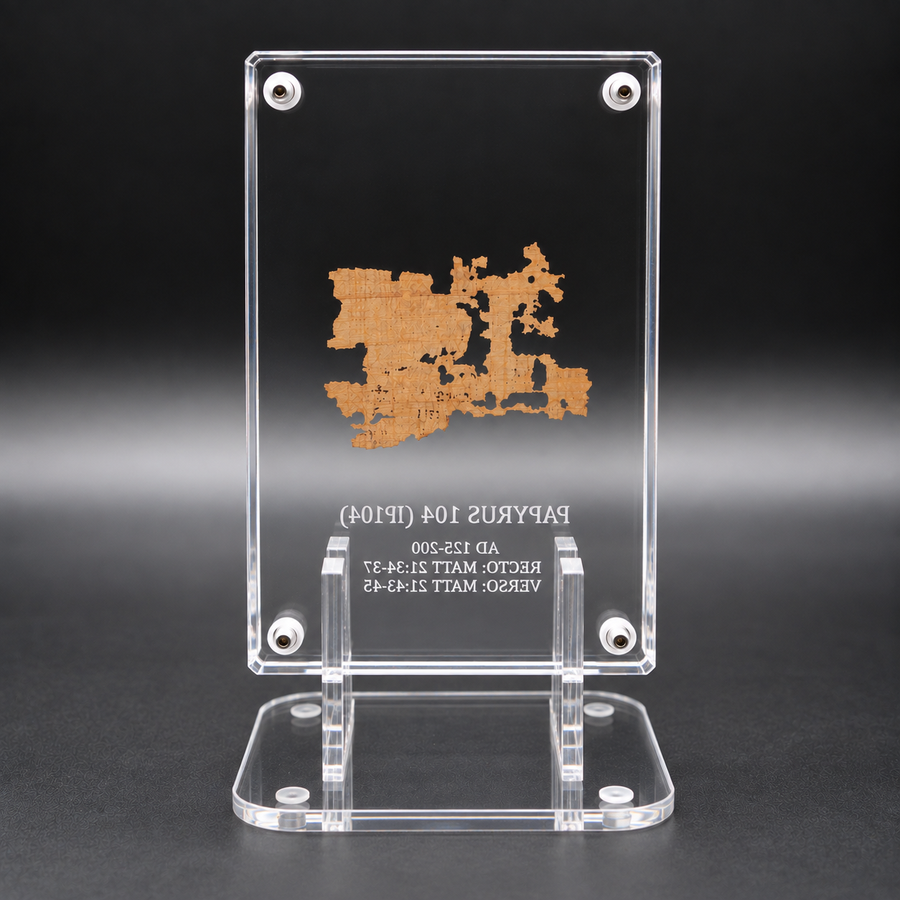
A parable of judgment,
on a second-century scrap.
On the front of this tiny leaf, Jesus is telling the chief priests and elders the Parable of the Wicked Tenants. A landowner sends his servants to collect the fruit of his vineyard, and the tenants beat and kill them; at last he sends his son — “They will respect my son” — but the tenants say, “This is the heir. Come, let’s kill him and seize his inheritance,” and throw him out of the vineyard and kill him. It is Jesus’ own picture of the rejection he is about to suffer.
Turn the leaf and you reach the verdict: “The kingdom of God will be taken away from you and given to a nation producing its fruits” — and the moment the chief priests and Pharisees “perceived that he was speaking about them.” Though only a fragment the size of a matchbook survives, 𝒫104 is one of the earliest copies of Matthew known to exist, written within a century or so of the Gospel itself.
From the evangelist’s century to yours
The Parable of the Tenants
The front preserves Matthew 21:34–37 — the servants sent and killed, and the son sent last; the back preserves 21:43 and 45 — the kingdom given to “a nation producing its fruits,” and the priests realizing Jesus means them.
Matthew 21:37–38
“But afterward he sent to them his son, saying, ‘They will respect my son.’ But the farmers, when they saw the son, said among themselves, ‘This is the heir. Come, let’s kill him and seize his inheritance.’”
Matthew 21:43
“Therefore I tell you, the Kingdom of God will be taken away from you, and will be given to a nation producing its fruit.”
Made by hand, made to order.
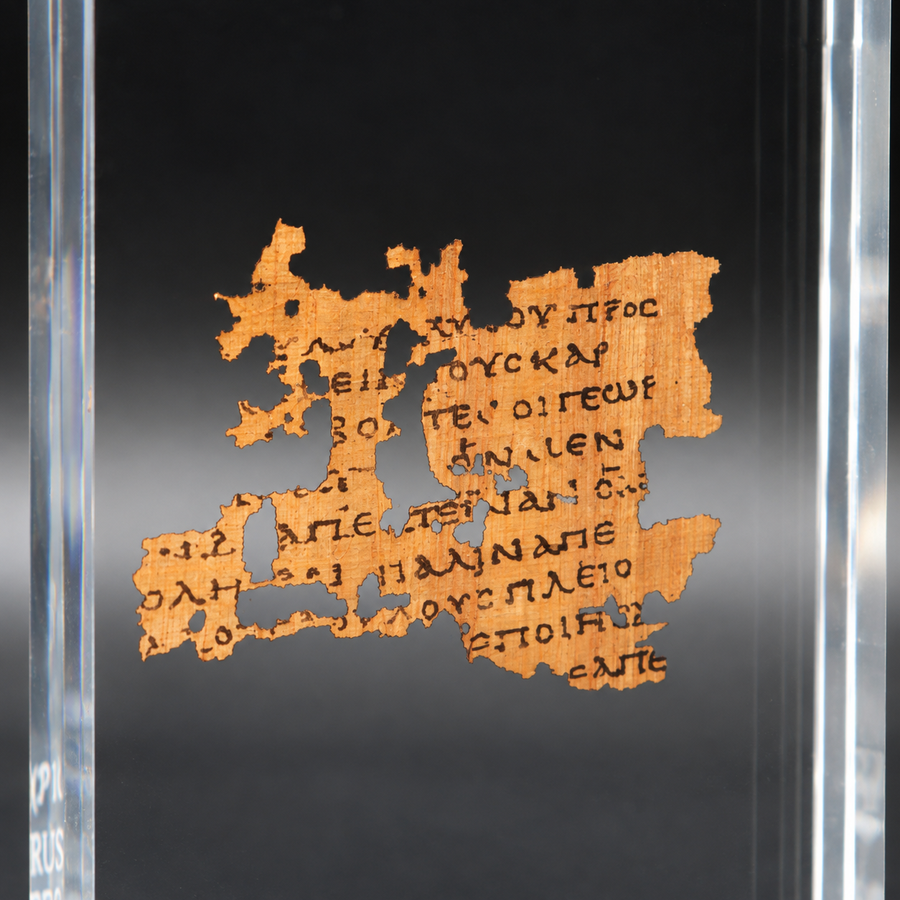
Dated to the second century, 𝒫104 is one of the very oldest surviving copies of Matthew, comparable in age to the celebrated P52 of John. Its careful, serifed literary hand points to a trained scribe. It is also textually famous: the verso preserves the transition straight from verse 43 to verse 45, giving the earliest surviving witness to the omission of Matthew 21:44 — the reading followed by the modern critical editions (NA28, UBS5). For a scrap the size of a matchbook, it carries remarkable weight.
Common questions
Is this really that old?
Yes — P104 is dated to the second century AD, which places it among the very oldest surviving fragments of the Gospel of Matthew, comparable in age to the famous P52 fragment of John.
Is the display stand included?
The stand is optional. Choose “Add the engraved stand” to have it shown upright as in the photos, or “Replica only” for the framed piece on its own.
Is it really made on papyrus?
Yes — every replica is reproduced on genuine Egyptian papyrus, then set by hand in a front-and-back acrylic display so both sides are visible.
How long does it take to ship?
Each piece is made to order through a multi-week hand-replication process. Your exact timeline is shown at checkout, and we ship to the US, UK, Canada, Australia, and Europe.
Can I see the text translated?
Yes — the companion reading page carries the passage in full, with a word-by-word interlinear and translation, and explains the famous omission of Matthew 21:44.
The Parable of the Tenants —
on your shelf.
Museum-grade, made to order, and framed to be read from both sides.
