

Woe and Lament
Among the earliest surviving pages of Matthew — Jesus' woes and his lament over Jerusalem. Reproduced at true scale on genuine Egyptian papyrus, framed in acrylic.
& 23:35–39
Egypt
Library, Oxford
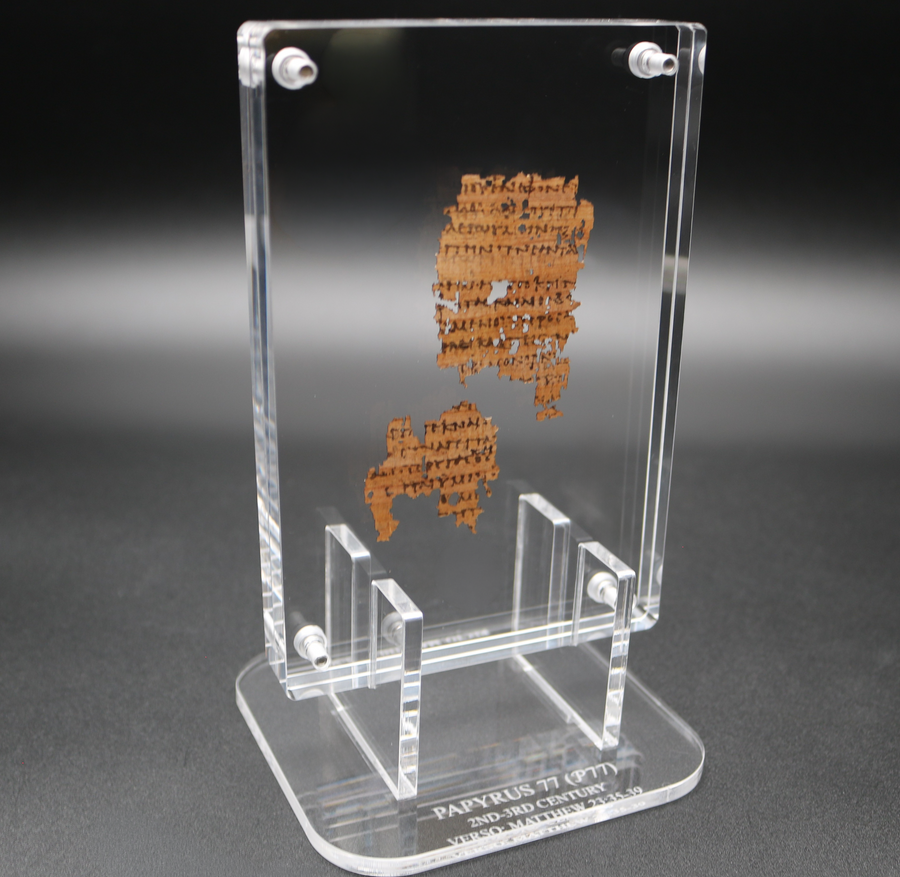
The woes — and the
lament over a city.
This leaf holds Jesus at his most severe and his most tender in the same breath. It preserves the last of his woes against the religious leaders, and then the turn no reader forgets — the lament over Jerusalem: “how often I would have gathered your children together, even as a hen gathers her chicks under her wings, and you would not.” Judgment and heartbreak, on one small page.
𝒫77 is among the earliest surviving leaves of Matthew's Gospel — an early Greek manuscript tied to the Alexandrian text tradition, the family of readings scholars trust most. Some believe it once belonged to the same original codex as Papyrus 103. Copied in Egypt within roughly a century of Matthew itself, it is as close as the physical record brings us to the evangelist's own page.
From the apostle's century to yours
Jerusalem, Jerusalem
Jesus' lament over the city, on one of the earliest surviving leaves of Matthew.
Matthew 23:33–34
“You serpents, you offspring of vipers, how will you escape the judgment of Gehenna? Therefore, behold, I send to you prophets, wise men, and scribes.”
Matthew 23:37
“Jerusalem, Jerusalem, who kills the prophets… how often I would have gathered your children together, even as a hen gathers her chicks under her wings, and you would not!”
Made by hand, made to order.

𝒫77 is an early Greek manuscript associated with the reliable Alexandrian text tradition, and may belong to the same original codex as Papyrus 103. As one of the earlier surviving pages of Matthew, it sits close to the source of the text translators still work from today.
5 out of 5
Wonderful
Amazing, well worth it!
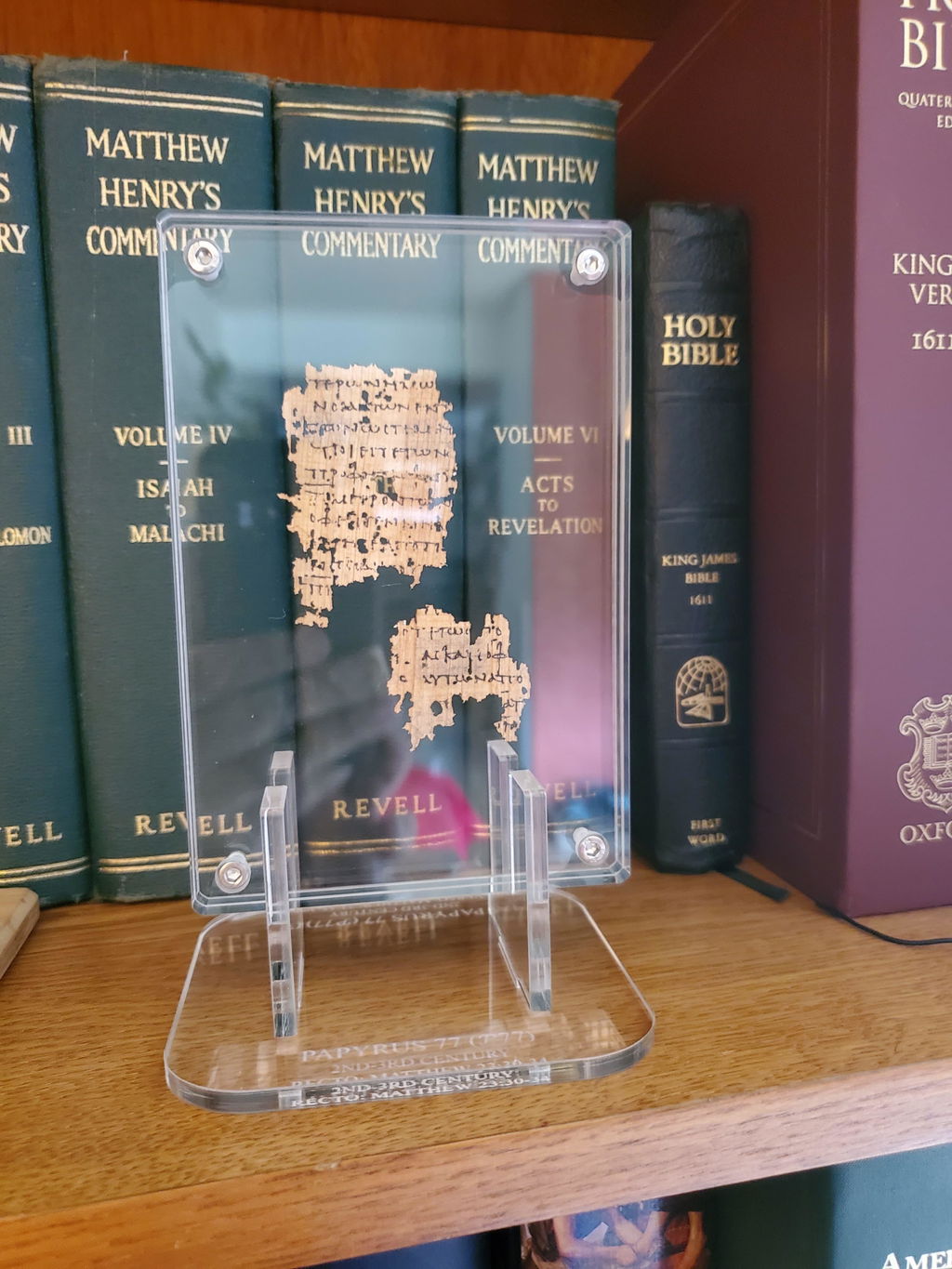
Amazing product.
🙌 great work!
Common questions
Is the display stand included?
The stand is optional. Choose “Add display stand” (+$10) to have it shown upright as in the photos, or “Replica only” for the framed piece on its own.
Is it really made on papyrus?
Yes — every replica is reproduced on genuine Egyptian papyrus, then framed by hand in an acrylic display.
How long does it take to ship?
Each piece is made to order through a multi-week hand-replication process. Your exact timeline is shown at checkout, and we ship to the US, UK, Canada, Australia, and Europe.
Can I see the text translated?
Yes — every leaf has a companion reading page with a full interlinear transcription and translation, letter by letter.
Among the earliest pages
of Matthew — on your shelf.
Museum-grade, made to order, and framed to be studied.
