

Galatians into Philippians
The remarkable leaf where one book of the Bible ends and the next begins — Galatians into Philippians — reproduced at true scale on genuine Egyptian papyrus in a front-and-back acrylic frame.
& Philippians 1:1–15
(Chester Beatty Papyri)
Library, Dublin
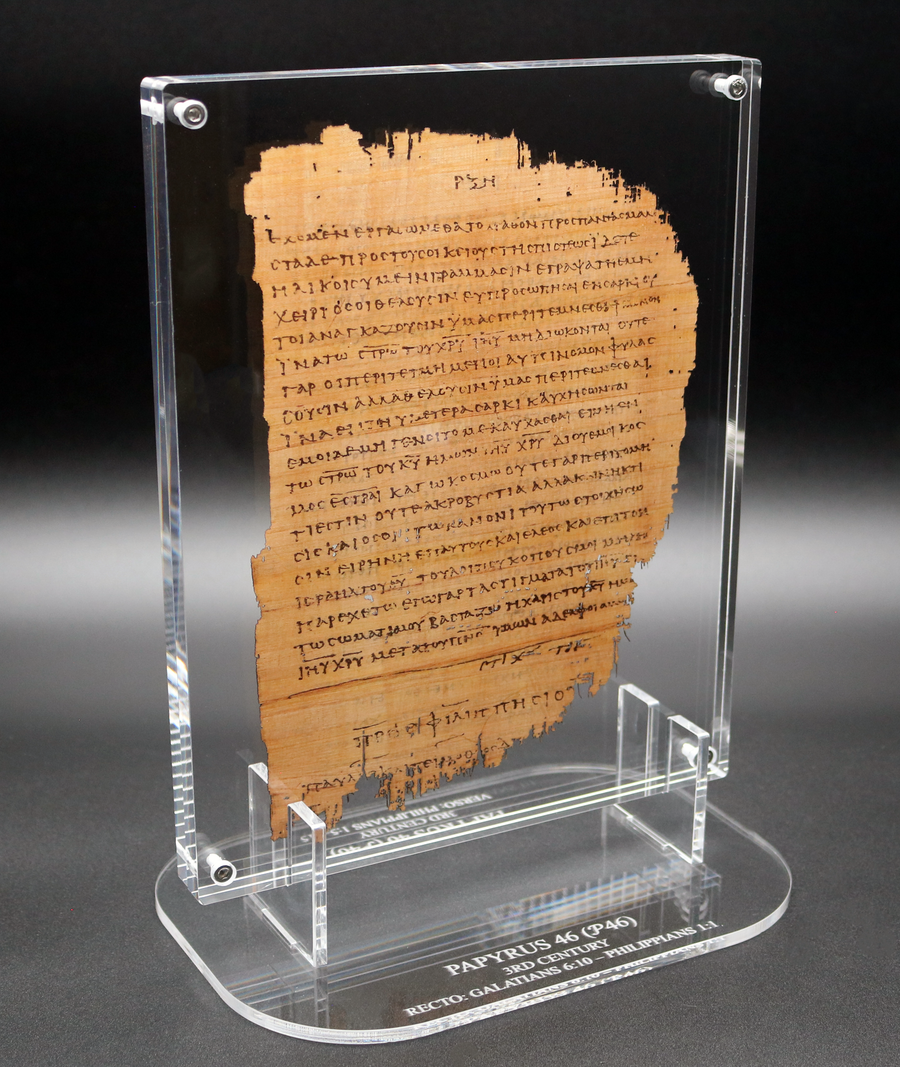
Where one letter ends
and the next begins.
Watch it happen on a single sheet. Galatians closes — “The grace of our Lord Jesus Christ be with your spirit, brothers. Amen.” — and then, in the scribe's own hand, the title ΠΡΟΣ ΦΙΛΙΠΠΗΣΙΟΥΣ, “To the Philippians,” and a new letter opens. Two books of the New Testament, meeting on one page, exactly as an early Christian would have turned to them.
This is one of the most revealing pages in early manuscript history. It shows that the earliest Christians experienced their Bibles not as separate books but as a continuous collection, gathered and copied together. The leaf even preserves the scribe's stichometry — the line counts used to reckon a copyist's pay — and one of the earliest Christian uses of the tau-rho staurogram, a scribal shorthand for the cross itself.
From Paul's pen to yours
Two letters, one page
Galatians closes and — in the scribe's own hand, titled ‘To the Philippians’ — Philippians opens, on a single leaf.
Galatians 6:14–18
“But far be it from me to boast, except in the cross of our Lord Jesus Christ… The grace of our Lord Jesus Christ be with your spirit, brothers. Amen.”
Philippians 1:1–2
“Paul and Timothy, servants of Jesus Christ, to all the saints in Christ Jesus who are at Philippi… Grace to you and peace from God our Father.”
Made by hand, made to order.
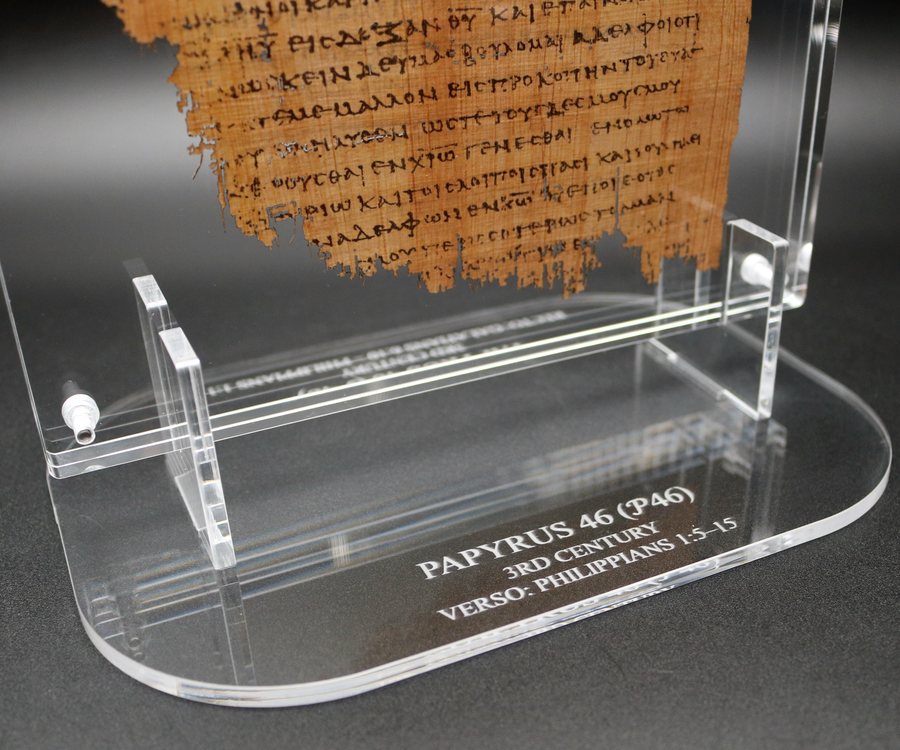
Galatians ends and, with the scribe's own handwritten title ΠΡΟΣ ΦΙΛΙΠΠΗΣΙΟΥΣ (“To the Philippians”), Philippians begins on the same page — proof that the earliest Christians experienced their Bibles as a continuous collection. The leaf preserves the scribe's stichometry, the line counts used for payment, and one of the earliest Christian uses of the tau-rho staurogram.
Common questions
Is the display stand included?
The stand is optional. Choose “Add display stand” (+$20) to have it shown upright as in the photos, or “Replica only” for the framed piece on its own.
Is it really made on papyrus?
Yes — every replica is reproduced on genuine Egyptian papyrus, then framed by hand in a front-and-back acrylic display.
How long does it take to ship?
Each piece is made to order through a multi-week hand-replication process. Your exact timeline is shown at checkout, and we ship to the US, UK, Canada, and Australia.
Can I see the text translated?
Yes — every leaf has a companion reading page with a full interlinear transcription and translation, letter by letter, including the scribe's own title line.
Two books, one page —
on your shelf.
Museum-grade, made to order, and framed to be studied from both sides.
